

The Boardroom as Your Lab: How Modern Executives Turn Real-World Problems Into Doctorate Breakthroughs?
Somewhere in your workweek, a question keeps nagging at you…
Why do your best hires leave within eighteen months?
Why does every cross-border project stall at the same approval stage?
Why does a product thrive in one market and flop in another just a few hundred kilometres away?
Most of us shrug these off as "just how business works." Doctorate researchers do something different. They write the question down and take it seriously. If you've considered a PhD in Business Administration online but keep tripping on the first hurdle, "What would I even research?", here's the good news. You may already be standing in your research lab.
The days when pursuing a Doctorate required stepping away from your career to sit in a library for five years are over. Today, the most impactful business research does not happen in isolated university lecture halls; it happens inside active enterprises, global supply chains, and fast-scaling tech companies. By treating your daily workplace as a living laboratory, you can transform the immediate operational challenges of your industry into high-impact academic research that advances both global business knowledge and your executive career.
Your Workplace Is a Living Case Study
Academic researchers frequently spend months negotiating access to real organisations. You already have it. Every day you watch decisions made under pressure, strategies that quietly succeed or collapse, and teams adapting to change. That lived context is hard to replicate from a library desk.
But experience alone isn't a research topic. An observation says, "This keeps happening." A research question asks, "Why does this happen, under what conditions, and what could change it?" A Doctorate programme trains you to make that leap, using rigorous methods and evidence to add something new to what the field knows.
The Ivory Tower Trap vs. The Executive Laboratory
Traditionally, academic research followed a top-down trajectory. Scholars read existing literature, identified a small theoretical gap, developed abstract hypotheses, and searched for a dataset to test them. While this approach served pure academia well, it often produced insights that felt disconnected from the velocity of modern commerce.
Executive research flips this script. When you pursue a PhD in Business Administration for working professionals, your daily environment becomes your primary scientific playground. You bring real-world data, complex human dynamics, and urgent market problems directly into your study. Instead of creating hypothetical scenarios, you study organisational behaviour, financial models, or strategic pivots as they unfold in real time.
This approach creates a powerful feedback loop:
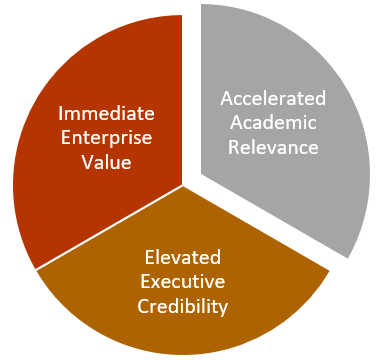
Immediate Enterprise Value: The frameworks and methodologies you master in your research are applied directly to your organization’s strategic roadmap.
Accelerated Academic Relevance: Your research reflects current market realities rather than stale, historical data.
Elevated Executive Credibility: You move from being a leader who operates on intuition to an authority who makes decisions grounded in empirical science.
Questions to Help You Find Your Topic
You don't need a flash of inspiration. You need a few of good questions and some patience.
1. Where does friction keep showing up?
Think about recurring problems: high turnover, slow decisions, supply chain surprises, stalled digital adoption. Repeating problems are research gold, because they suggest something systematic is going on.
2. Where do smart people disagree?
Notice the debates in your meetings. Is remote work boosting or hurting innovation? Does sustainability reporting change investor behaviour or just polish the brand? Honest disagreement often signals that the evidence isn't settled.
3. What does the existing research say?
Before you fall in love with an idea, spend a few weeks reading. Search scholarly databases for your theme. Look for a gap, such as an under-studied region, industry, or time period, or a finding that hasn't been tested outside the context where it began. A strong topic sits where your practical insight meets an open scholarly question.
4. Can you realistically study it?
Good ideas die on practical rocks. Ask whether you can access the data, participants, or documents you'd need. Consider confidentiality and ethics, especially if the research touches your employer. And check that the scope fits your time. "How does leadership affect performance?" is a lifetime of work. "How do hybrid-work policies shape middle-manager decision-making in mid-sized logistics firms?" is a dissertation.
5. Will you still care in year three?
Doctoral work is a long conversation with one idea. Pick something that will keep you curious on the tired Tuesday evenings when motivation dips. It should also matter enough that others in your field will want to read the results.
A Quick Picture of What This Looks Like
Imagine a supply chain manager in Nairobi who notices that mobile-payment adoption among small suppliers changes how quickly they can be paid, and how willing they are to take on bigger contracts. Or a finance lead in Toronto curious about how ESG disclosure affects the way mid-sized firms raise capital. Or a marketing director in Singapore asking why consumer trust in AI-driven recommendations differs so sharply between age groups.
None of these needed a laboratory. Each began with a professional paying attention, and each can grow into a defensible research question.
Choosing a Format That Fits Your Life
Finding a topic is half the story. The other half is finding a way to pursue it without pausing your career, your family, or your income.
That's why a PhD in Business Administration online has become a serious option for professionals around the world. Online delivery means you can study across time zones, keep your job, and still work with faculty and peers.
A PhD in Business Administration for working professionals is typically designed around that reality, with flexible pacing, structured research milestones, and supervision that respects your schedule. When you compare programmes, look at a few things:
- How research methods are taught and supported?
- How supervisors are matched to your topic?
- Whether the curriculum encourages applied research from your own workplace?
- How the programme supports you through the dissertation phase, which is where many students stall?
Traps Worth Avoiding
Going too broad. A topic that sounds impressive but can't be measured won't survive its first proposal review.
Chasing buzzwords. Trends fade, but a well-framed question about decision-making, trust, or organisational change stays relevant.
Choosing your answer first. Research means being willing to find out you were wrong. That's where the real contribution often hides.
Ignoring confidentiality. Talk to your employer early if your study involves internal data or colleagues.
Turn Your Daily Work Into Your Legacy
A PhD in Business Administration online is more than just three letters after your name. It represents a fundamental shift in how you think, analyze information, and lead. By turning your workplace into your research lab, you eliminate the artificial barrier between theory and practice. You stop viewing organisational challenges as mere operational headaches and start seeing them for what they truly are: opportunities to create new knowledge, build enduring competitive advantages, and establish your legacy as a visionary leader in your field.
FAQs
1. How do I balance a PhD in Business Administration for working professionals with a full-time executive role?
By choosing a dissertation topic directly embedded in your daily work, your career and research become mutually supportive rather than competing priorities. Modern PhD in Business Administration online programmes utilise asynchronous coursework, cohort-based scheduling, and strategic research milestones designed to fit around senior executive commitments.
2. What is the difference between a traditional PhD in Business Administration and an executive PhD/DBA?
While both are terminal Doctorate degrees requiring original research and a defended dissertation, traditional PhDs typically focus on training full-time tenure-track university professors through abstract theoretical study. An executive doctorate or PhD in Business Administration for working professionals focuses on applied research, using scientific methodologies to solve complex, real-world business problems faced by contemporary global enterprises.
3. How do I pitch my workplace Doctorate research to my company for tuition support or sponsorship?
Frame your research proposal as an internal strategic initiative with tangible ROI. Demonstrate how your research will address a persistent corporate inefficiency, inform executive decision-making, or develop a proprietary operational framework for the business. When leadership sees that your Doctorate studies act as a dedicated R&D engine for the company, securing executive sponsorship and data access becomes significantly easier.

Comments & Replies
Read what others are saying and share your thoughts below.
Leave a Reply