

Mental Health Needs More Than One Lens: Why Bridging Disciplines Matters?
Mental health doesn't live in a single room nowadays. It stretches across classrooms, workplaces, hospitals, family dinner tables, and uncountable in-between spaces that no single profession can completely claim. And yet, for decades, the way we trained people to address it remained stubbornly siloed, clinicians in one lane, educators in another, sociologists in a third, hardly pausing to compare notes. That is finally starting to change, and the change couldn't be more immediately needed.
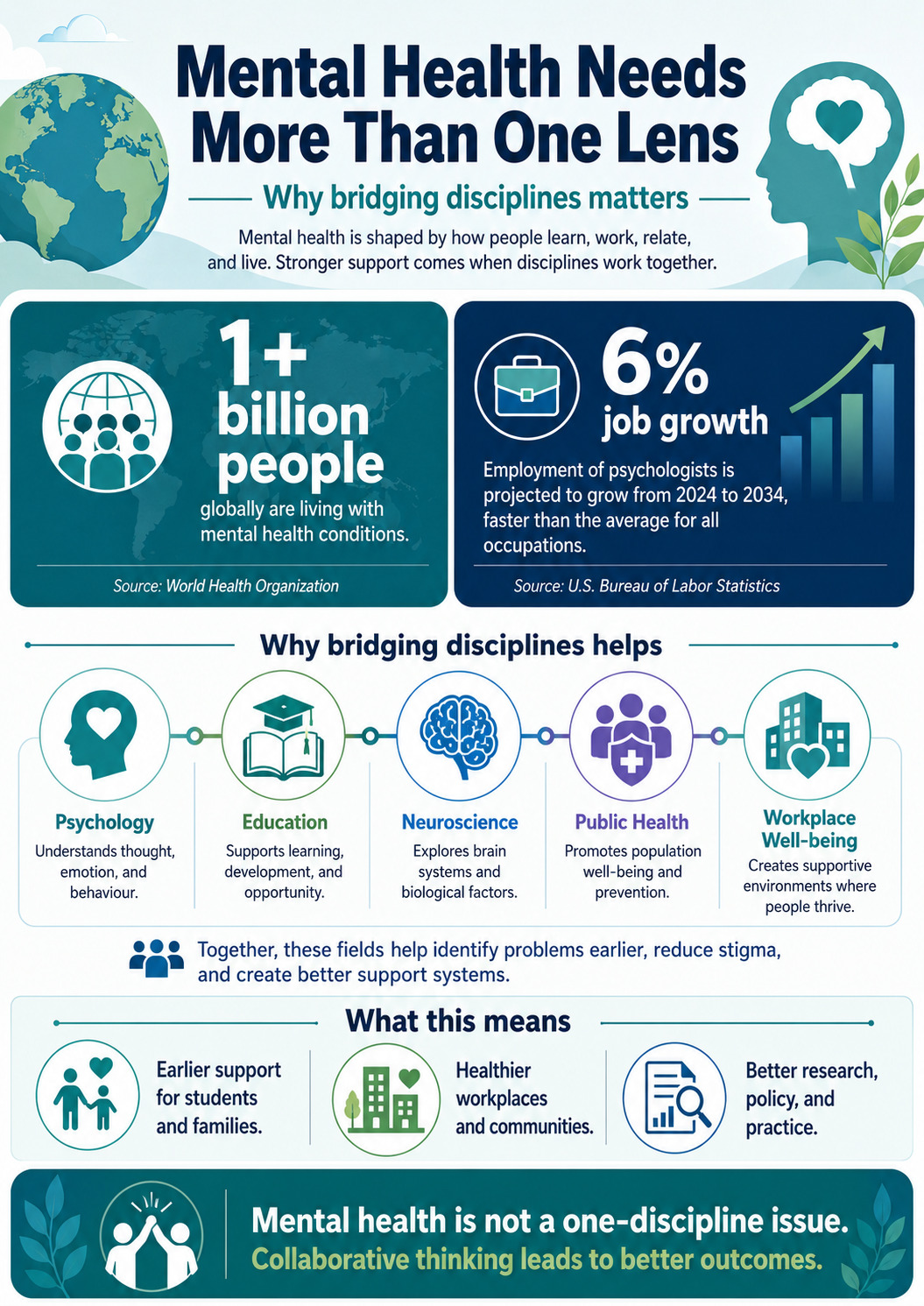
More than 1 billion people worldwide are presently living with a mental health disorder, according to the World Health Organization's 2025 reports. That number isn't a turning error, it's roughly 1 in 8 people. And yet, despite the scale of the disaster, access to care remains staggering in its insufficiency. According to WHO data, 91% of people living with depression worldwide are unable to access the care they want. A separate 2025 study published in JAMA Psychiatry found that only 6.9% of people with mental health or substance use disorders really receive effective conduct. Read that again: fewer than seven in a hundred.
So, what's going wrong and more suggestively, what does get it right really look like?
The Real Cost of Professional Silos
Part of the answer lies in how we've usually approached mental health as a problem for specialists to solve. Psychiatrists handle the clinical and counselors handle the emotional. Educators handle the academic. Social workers handle the organizational. Each group is skilled intensely within its own framework, which is valuable but it also means that a student struggling in school hardly gets the full picture of why she's struggling.
- Is it a learning difference?
- A trauma response?
- Household instability?
- Untreated anxiety?
Typically, it's some layered combination, and a siloed system isn't built to see the whole person.
Research gradually backs this up. A 2025 study in Frontiers in Psychology found that most health-education programs focus mostly on the cognitive aspects of health knowledge while overlooking educational-psychological dimensions such as motivation, emotion regulation, and social support thereby restraining their real-world effectiveness. When disciplines don't talk to each other, the person who needs help falls through the cracks between them.
Why Education Has a Major Role to Play?
Schools and universities are frequently the first places where signs of mental distress become visible. A child who suddenly loses interest in learning, a teenager who becomes aggressive, or a student who performs well but continuously fears failure may all be showing signs of deeper emotional struggle.
Teachers are not expected to become psychotherapists. Nevertheless, they are frequently the adults who notice changes first. When educators understand emotional development, learning behaviour, motivation, and mental health warning signs, they can respond with better sensitivity.
This is one reason why numerous professionals are exploring advanced study pathways such as a PhD in Educational Psychology. The field brings together learning science and psychological understanding, helping professionals study how people think, feel, learn, behave, and adapt across different educational settings. It also supports research into questions that matter globally:
- How does anxiety affect learning outcomes?
- What classroom practices support emotional safety?
- How can schools identify learning and behavioural concerns early?
- How do culture and family systems influence student well-being?
- What makes inclusive education emotionally supportive?
These questions cannot be answered by one discipline alone.
The Numbers Are Telling a Story
The career landscape for individuals working at this intersection is growing fast. According to the U.S. Bureau of Labor Statistics, overall employment of psychologists is projected to grow 6% between 2024 and 2034, faster than the average for all occupations, generating approximately 12,900 new openings annually. But the more striking figure concerns end-to-end roles: substance abuse, behavioral disorder, and mental health counselors are projected to see 16.8% growth over the same period, adding roughly 81,000 new jobs. Marriage and family therapists are expected to grow 13%.
What these numbers show isn't just that there are jobs existing. They reflect a genuine, systemic acknowledgement that mental health expertise is needed at every level of public life schools, community centers, healthcare settings, policy offices, and organizations of every size.
Globally, the Gaps Are Different but the Need Is the Same
While U.S. data tends to control headlines, this is a global conversation. In low- and middle-income countries, the mental health workforce gap is even more severe, and the need for professionals who understand both community-based education and psychological support is especially acute. In regions where, clinical care is mostly inaccessible, the front line of mental health intervention is often a teacher, a community leader, or a public health worker.
This is why interdisciplinary training matters not just educationally, but practically. When a school counselor in Nairobi, a health educator in Manila, or a community outreach worker in rural Brazil understands developmental psychology, they become far more effective in roles that formal mental health systems may not yet reach. A PhD in Educational Psychology, for example, creates professionals who can do research, design interventions, train educators, and advocate for policy all of which are measurements that translate across borders and contexts.
Actionable Tactics: How to Build Bridges in Your Domain?
You do not need to wait for basic institutional updates to start practicing an interdisciplinary approach to mental health. Whether you are an educator, a business leader, or a technology designer, you can introduce these values into your daily workflow:
-
Analyze Systems, Not Just Variables: When an individual on your team or in your classroom shows signs of intense stress or declining performance, resist the urge to view them as an isolated issue. Look at the systemic context. Is the communication flow causing cognitive overload? Is the environmental architecture inducing a chronic stress response?
- Leverage Behavioral Insights Data: Mental wellness issues do not appear out of thin air; they leave subtle behavioral trails. Tracking aggregate engagement patterns, absenteeism, and feedback loops can help you pinpoint structural friction points before they escalate into acute clinical crises.
- Pursue Dynamic Upskilling: If your background is deeply rooted in education or management, invest time in understanding basic behavioral neuroscience or trauma-informed leadership. If you are already trained in psychology, expand your horizon into organizational design, instructional technology, or sociology.
What This Means for You?
If you're an apprentice weighing your next academic step, or a practitioner wondering whether deeper specialization or wider training would serve you better, the evidence is pretty clear: the mental health challenges of the coming decades won't be solved by people who only speak one disciplinary language.
The most effective specialists in this space will be those who can hold difficulty who understand the neurological and the social, the educational and the clinical, the individual and the systemic. Graduate-level programs that bridge these fields, whether a PhD in Educational Psychology, a research-focused public health degree, or a counseling program built around interdisciplinary practice, are preparing people for work that actually reflects the full picture of human experience.
Mental health doesn't live in a single room. But fortunately, neither do you. Whether you are a prospective student exploring graduate programs, a working professional seeking to deepen your impact, or an educator looking to better support the people in your care, the invitation is the same: step across the disciplinary line. The people who need help are already living there.
FAQs
1. Why is mental health important in education?
Mental health affects attention, motivation, behaviour, confidence, and learning outcomes. When students feel emotionally supported, they are more likely to participate, engage, and perform better.
2. How can different disciplines help improve mental health support?
Psychology explains emotions and behaviour, education focuses on learning environments, neuroscience studies the brain, and public health looks at prevention and access. Together, they create more complete solutions.
3. Is mental health only a clinical issue?
No. Mental health is also connected to schools, workplaces, families, communities, culture, and social conditions. That is why support must go beyond diagnosis and treatment.
4. What is the role of educational psychology in mental health?
Educational psychology studies how people learn, think, behave, and develop emotionally. It helps professionals understand student needs, learning barriers, motivation, and well-being.
5. Who can pursue a PhD in Educational Psychology?
Educators, counsellors, school leaders, psychologists, trainers, researchers, and professionals interested in learning, behaviour, mental health, and human development can consider this path.
6. Can a PhD in Educational Psychology support career growth?
Yes. It can open opportunities in research, higher education, educational consultancy, student support, policy development, inclusive education, and institutional leadership.
7. Why does mental health need a global perspective?
Mental health challenges differ across cultures, countries, and communities. A global perspective helps professionals design support that is inclusive, culturally aware, and practical.
8. How can workplaces benefit from mental health awareness?
Workplaces that understand mental health can reduce burnout, improve communication, support employee well-being, and create healthier professional environments.


Comments & Replies
Read what others are saying and share your thoughts below.
Leave a Reply